
 01
01Too many starting points.
Every new book or video gives you another thing to work on. Choosing one becomes its own task.
YOUR GUIDE. YOUR WAY.


Phone · tablet · computerFill in. Save. Return.
Prefer paper?Print selected pages.
ONE THING AT A TIME · FOR LIFE AFTER 30
Saved the tips. Read the books. Still wondering where to start? Choose one priority, turn it into a manageable action, and build a plan around the week you actually have.
One place to read, make a plan, and come back to it. Start with energy, sleep, meals, or movement. You don’t have to work on everything at once.
Regular $69.99
Guided, fillable PDF · Phone, tablet, or computer
Personalize. Fill in. Save. Reuse. Print if you prefer.
WHEN READING DOESN’T BECOME DOING
A useful idea can stay in a bookmark when there is no clear place for it in your day. Does any of this sound familiar?
01Every new book or video gives you another thing to work on. Choosing one becomes its own task.
 02
02The routine looks good on paper, until work, family, or a change of plans takes over.
 03
03The advice is in one place. Your notes are in another. There is no simple way to review the whole picture.
 04
04When the full plan no longer fits, the next move is unclear.
 05
05A few missed days can leave you wondering whether to begin all over again.
 06
06Without a brief record, deciding what to keep can feel like another guess.
One Thing at a Time brings the reading, the worksheets, and the daily practice into one guided structure.
See the complete guideExplanations, a guided program, and practical tools. Click any page to explore.
16 real sample pages · tap the page to open the reader.
THE GUIDE + INCLUDED READER BENEFITS
A practical method for the years ahead.
A book to understand. A working copy to use. Read the explanation, complete a guided page, and save your next step in the same PDF.
A 336-page guided PDF combining plain-language explanations, illustrated examples, a 30-day practice path, and reusable tools. Built for adults over 30 with real schedules.
Guide + 16 worksheets + 8 bonuses
12 months of updates + 2 years of private blog access
Private blog: opening in 2027. Your 2 years of access start when it opens.
Payment options at checkout
Digital PDF · No physical product or device included
THERE’S SUBSTANCE BEHIND EVERY STEP
Read the explanation, recognize an everyday situation, and use a practical page to choose what comes next. The worksheets are one part of the book.
INSIDE ONE THING AT A TIME
Watch, choose, plan, shrink, note, and review.
Guide pages 18–21
Start with observation. Make room for repetition and review.
Guide pages 130–253Notice the shape of your day before choosing where to act.
Guide pages 71–85
Look at the hours before bed and the routines around them.
Guide pages 86–96
Plan around availability, time, and your actual week.
Guide pages 97–107
Explore how a manageable practice could fit your schedule.
Guide pages 108–118Use the fields in your PDF, save your notes, and return when you have time.
Guide pages 262–281
A quick start, weekly planner, restart page, and more.
Guide pages 284–300START WITH THE PART OF YOUR DAY THAT BROUGHT YOU HERE
You can explore one area first. The same observation, planning, and review process runs through all four.
Part 6 · Pages 71–85Start with the shape of your day.
Explore this partPart 7 · Pages 86–96Give the end of your day a little more structure.
Explore this partPart 8 · Pages 97–107Make the busy moment easier to plan for.
Explore this partPart 9 · Pages 108–118Find a starting place that fits your space and week.
Explore this partFIND YOUR STARTING POINT
Explore how the tools can organize four everyday situations.
01 · A SITUATION YOU MAY RECOGNIZEAdvice that assumes spare time can be hard to use.
Notice one repeatable moment in your day. Give one action an existing cue and a smaller version.
02 · A SITUATION YOU MAY RECOGNIZEA long wind-down checklist can become one more unfinished task.
Look at the routine before bed. Choose one realistic preparation step and a shorter version for late evenings.
03 · A SITUATION YOU MAY RECOGNIZEAn ambitious weekly menu can lose its place when plans change.
Identify the busy moment and prepare one practical option before it arrives.
04 · A SITUATION YOU MAY RECOGNIZEAn all-or-nothing plan offers little help when you miss a few days.
Keep a route back: a manageable starting point, a smaller action, and a date to review it.
FOR LIFE AFTER 30
In your 30s, 40s, 50s, or 60–70: start with the week you actually have. Tap a stage to explore one way the method could fit.

YOUR LIFE. YOUR STARTING POINT.
If work, home, and changing plans keep competing for attention, start with one moment you can realistically organize.
After checking tomorrow’s calendar, choose one lunch option you can have ready.
Constraints sheet · Action card · Food Organization

YOUR LIFE. YOUR STARTING POINT.
When other commitments interrupt your routine, decide in advance what the manageable version will be. A few missed days can have a clear route back.
After dinner, write tomorrow’s first task. On a crowded evening, one line is enough.
If-then card · Bad-day plan · Restart page

YOUR LIFE. YOUR STARTING POINT.
If a familiar routine no longer fits, use a brief review to choose what to keep, adjust, or set aside. Start from the life you have now.
Review one routine, choose its smallest useful version, and put the next review on your calendar.
Weekly review · Maintenance card · Low-friction variants

YOUR LIFE. YOUR STARTING POINT.
When your schedule opens up or changes, a few familiar cues can give a chosen action a place. Build around the day you actually have, at a pace you choose.
Map a start, a real break, and a close. Choose one existing moment for your next small action.
Day map · Day skeleton · One-page summary
One guide. One adaptable method. These are examples; your schedule and priorities shape your own plan.
Avery · 29
Finding a starting point
Avery · 29
Avery has collected plenty of advice, but each new routine seems to come with another list. Choosing where to begin has become its own task.
Use the Day map to describe three ordinary days. Then use the Priority card to choose one part of the day to organize first.
Keep the first note to a few lines. Leave the other topics for later and review whether the chosen priority still fits.
A place to begin without trying to change everything.
Your starting pages Part 4 · Your starting point, p. 59. Sheets 01 and 05 · pp. 262, 268.
Explore the complete guide, price and what’s included.
Find my starting pointJordan · 33
Keeping it going
Jordan · 33
A routine built around a quiet morning does not match Jordan's household. Even a good intention can disappear when pickup runs late or a meeting moves.
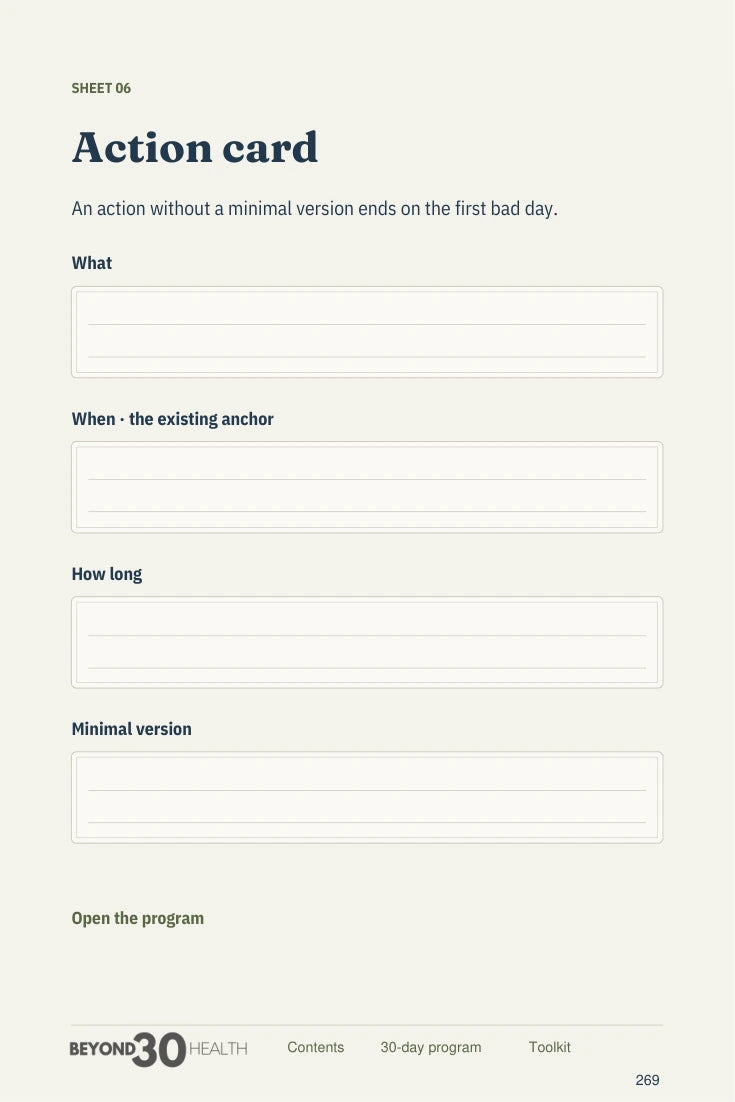
Give one action a cue that already exists, such as clearing the lunch dishes. Write a smaller version on the Action card before the busy day arrives.
Use an if-then plan for one predictable interruption. If that cue disappears, choose the next realistic opportunity rather than adding a catch-up session.
A plan with a busy-day version built in.
Your starting pages Part 3 · pp. 49–50. Day 12 · p. 181. Sheets 06 and 07 · pp. 269–270.
Explore the complete guide, price and what’s included.
Build a plan for my weekDavid · 36
Keeping it going
David · 36
David can follow a demanding plan for a few days. When work gets busy, missing the full routine feels like a reason to stop completely.
Use the Action card to define a realistic action and its smallest useful version. Write a restart cue while the week is still calm.
Leave missed days blank. Return with the smaller action, then use the Weekly review to keep, change or drop what does not fit.
A way back in, without turning a gap into a verdict.
Your starting pages Part 3 · pp. 50–53. Day 20 · p. 214. Weekly review · p. 276. Restart page · p. 293.
Explore the complete guide, price and what’s included.
Plan a gentler restartNina · 39
Evenings & sleep
Nina · 39
Nina's evening drifts from unfinished work to scrolling. The aim is to organize that transition, starting with something she can actually control.
Notice what keeps the evening open. Choose one closing cue, such as shutting the laptop and writing tomorrow's first task on one line.
Keep the cue small on busy nights. Use brief notes to review whether it fits the household, without treating the notes as a sleep score.
One recognizable cue to start winding down.
Your starting pages Part 7 · Sleep and evening, pp. 88–93. Action card · p. 269.
Explore the complete guide, price and what’s included.
Explore a simpler eveningMarcus · 43
Daily energy
Marcus · 43
Some afternoons Marcus rereads the same paragraph; other days the issue is a task he has been avoiding. Calling both moments 'tired' leaves little to work with.
Start with the guide's distinction between sleepiness, lower alertness and drained motivation. Note the time and context, then choose one practical pause or movable task.
Keep the observation short. Review whether the change fits the day; new, persistent or worsening fatigue belongs in a conversation with a healthcare professional.
A more specific question than 'Why am I always tired?'
Your starting pages Part 6 · Energy and alertness, pp. 73–82. Energy dips sheet · p. 264.
Explore the complete guide, price and what’s included.
Understand my daily patternsElena · 46
Meal organization
Elena · 46
By the time dinner comes around, Elena has already made enough decisions. A detailed meal-prep system adds work instead of fitting the week.
Choose one meal to organize. Write a short grocery list and make one practical option easy to find before the busiest part of the day.
Prepare only what will be useful. Use the weekly notes to simplify the setup; there is no need to turn food organization into another set of food rules.
A little preparation at the moment it can help.
Your starting pages Part 8 · Food organization, pp. 99–103. Day 16 · p. 199. Week planner · p. 287.
Explore the complete guide, price and what’s included.
Make room for easier meal planningPriya · 50
Support & gifting
Priya · 50
Appointments and family needs can reshape Priya's day. A fixed routine assumes control she does not always have, and a long checklist creates more pressure.
Use the Constraints sheet to name the time and support actually available. Choose one brief pause at a transition she can reasonably protect.
Use the Bad-day plan to decide what can be dropped. A conversation with someone supportive can help clarify the plan; sharing private workbook notes is optional.
A next step sized to the support and time available.
Your starting pages Part 4 · Constraints, pp. 59–60. Sheet 03 · p. 266. Day 18 · p. 207. Sheet 11 · p. 275.
Explore the complete guide, price and what’s included.
Find a step that fits my responsibilitiesAndre · 54
Movement at home
Andre · 54
Andre compares a small start with the routines he used to follow and puts it off. A demanding program is not what he is looking for right now.
Read Movement at home, then choose a comfortable, feasible starting action and a cue already in the day. Keep the first version deliberately modest.
Review the fit before adding more. Follow the guide's stop rules and seek individualized advice if pain, dizziness or health concerns affect what is appropriate.
Permission to start at a level that fits today.
Your starting pages Part 9 · Movement at home, pp. 110–115. Action card · p. 269.
Explore the complete guide, price and what’s included.
Explore a manageable starting pointRachel · 58
Keeping it going
Rachel · 58
Rachel can make a plan work until a week away changes the usual cues. Returning often turns into waiting for the next clean slate.
Use the Restart page to name the first small action back and the next realistic cue. Reopen the saved workbook without rewriting the days away.
If the schedule has changed for longer, use the Simplified routine sheet to choose what still belongs. Resume with a plan that fits the new week.
A return point, even when the week is different.
Your starting pages Part 3 · Interruptions, p. 53. Simplified routine · p. 279. Restart page · p. 293.
Explore the complete guide, price and what’s included.
Give my routine a restart pointThomas · 62
Finding a starting point
Thomas · 62
A recent move to part-time work has changed the shape of Thomas's day. The old schedule no longer provides the same cues, but a packed timetable does not appeal either.
Sketch the day as it is now. Choose one useful anchor around a meal, a comfortable activity or an existing commitment, then make room for it on the Day skeleton.
Leave space unplanned. Review what gives the day useful structure and remove what only makes it feel crowded.
A routine that reflects this season of life.
Your starting pages Part 4 · p. 59. Day 24 · p. 228. Day skeleton · p. 274. Simplified routine · p. 279.
Explore the complete guide, price and what’s included.
Shape a routine for this chapterDenise · 66
Finding a starting point
Denise · 66
Denise reads on her tablet and is comfortable keeping digital notes. What she does not want is another course to finish before she can begin applying an idea.
Open the chapter that matches the current priority. Read its explanation and evidence boundaries, then use the Action card to write one action, one cue and a smaller version.
Save a personal copy in a PDF reader that supports forms and reopen it to check the notes. Use the Weekly review to decide what deserves to stay.
Explanation, an action and a place to return to it.
Your starting pages Using your working spaces · p. 9. Part 3 · p. 47. Action card · p. 269. Weekly review · p. 276.
Explore the complete guide, price and what’s included.
See the guide and its practical toolsRobert · 67
Support & gifting
Robert · 67
A guide can be a welcome gift when it invites a conversation instead of assigning a new routine. Robert already uses a tablet and would like to explore the book in his own time.
Start with the contents and choose the chapter that interests him. If he wants company, discuss one priority together and leave the choice of action to him.
Type and save notes in a compatible PDF reader, or print one useful sheet. His completed notes stay in his saved copy; sharing them is his decision.
Support from someone close, with the choice kept personal.
Your starting pages Make this book yours · pp. 7–9. How to use this book · p. 47. Paper or phone · pp. 53–54.
Explore the complete guide, price and what’s included.
Explore a useful gift and the full offerNo exact match yet. Try another focus or explore all profiles.
A REASONING PATH YOU CAN FOLLOW
The guide includes 32 numbered source notes covering habit formation, progress tracking, light, sleep, meal organization, and movement, alongside additional background references.
 32numbered source notes
 2005–2025publication years represented in those notes15 partsexplanations, practice, tools, and references
WHAT THE STRUCTURE ADDS
When you build a plan from separate books, videos, and articles, you decide what to read, what to try, and how to track it. This guide brings those decisions into a guided structure.

SEPARATE BOOKS
Different authors bring depth and useful perspectives. You still decide which ideas belong together and where your plan and notes will live.
Choose one priority, translate the reading into an action, and create a shared place to review it.
$81 · four-book list-price example
See the four titles & price details
COURSES & SAVED VIDEOS
A course can give you guided teaching; a video can make a technique clear. Putting that lesson into your own week means deciding what to try and where to keep your notes.
Find it again, decide how it fits your day, and record what you actually tried.
$29.95 · one online sleep-course example
See the course & price details
SUBSCRIPTIONS
Classes, libraries, or support can be valuable. Before adding another membership, consider what you will use and how it fits the tools you already have.
Choose what to follow, check recurring costs, and keep a routine that survives a busy week.
$79.99/year · Calm annual-plan example
Explore the one-time guide purchase
ONE THING AT A TIME
Explanations, 30 guided days, and reusable tools sit in the same PDF. Follow the links from an idea to a practical page, then return to your review.
Research-informed explanations, a place to choose one priority, a smaller version for busy days, and a review of what deserves to stay.
— · one-time purchase
See everything includedCompare the way you will use each resource, as well as its price. The guide connects research-informed reading, guided practice, and your own review in a reusable file.
| The decision | Assembling your own plan | Inside this guide |
|---|---|---|
| Where to begin | Choose a starting point from your sources. | Clickable navigation, a day map, and a priority card. |
| What to do next | Turn ideas into your own action plan. | 30 guided days and an action card. |
| What to do on a busy day | Work out your fallback. | A smaller version and a bad-day plan. |
| How to keep track | Choose or create your tracking system. | 16 fillable worksheets you can save and reuse. |
| How to adjust | Decide when and how to review. | Weekly reviews and a restart page. |
| How to check a claim | Find and interpret the source. | References with plain-language limits. |
ONE ORGANIZED STARTING POINT
Books, courses, and apps can each offer something useful. This guide brings explanations, a practice path, and reusable worksheets into one place for —.
The value is in what you can do with it: understand an idea, choose your next step, save your own notes, and return to a clear review.
Reasoning you can follow32 numbered source notes and plain-English explanations put the research in context.A method already organizedEnergy, sleep, meals, and movement connect to the same 30-day practice path.Tools you keep using16 fillable worksheets and 8 bonuses give your decisions a place to live.Separate U.S. examples · checked October 11, 2026
Four specialist booksPublisher list-price totalOne online sleep courseHarvard Health PublishingOne meditation appCalm annual planHarvard Health Publishing’s Improving Your Sleep: Guide to a Good Night’s Rest: a self-paced online course listed at $29.95 on its program page.
Calm’s annual plan: $79.99 billed yearly after the trial, with access to its meditation and sleep library. At the time of this price check, a separate Calm for Life offer was also listed at $39.99. Plans and promotions can change.
Different resources, content, and formats. These prices are separate examples, not a combined bundle or a valuation of this guide. Prices and access terms can change.
A METHOD YOU CAN COME BACK TO
Three words hold the method. Six moves turn it into practice.
01 / 04 · WATCH
Begin with an observation, not a judgment. Notice where an ordinary day becomes harder to manage.
“My evenings run late because I start planning tomorrow at bedtime.”
02 / 04 · CHOOSE
Choose a step that fits the week you have. Give it a clear cue and a place in your day.
“After dinner, I’ll write tomorrow’s first task.”
03 / 04 · REPEAT
Leave room for an ordinary, imperfect day. Try the action, use its smaller version when needed, and make a brief note.
“On a late evening, I’ll write just one line.”
04 / 04 · KEEP
What felt workable? What needs to change? Use your notes to decide what to keep, adjust, or set aside.
“I’ll keep the after-dinner cue and make the task smaller on busy nights.”
Watch · Choose · Keep is the guide’s core method. Repeat makes room for practice between choosing and reviewing.
Understand the complete approach
WATCHDescribe what happens before deciding what it means.
CHOOSEPick a priority, plan around a cue, and prepare a smaller version.
KEEPRepeat and note. Keep, change, or drop the action as your week changes.
FROM THE IDEA TO THE EVERYDAY
Choose a step to see a short example and the worksheet that helps you use it. Start with the part you want to understand.
01 / 06

Notice your day before deciding what to change.
01 / 06 · WATCH
Describe one ordinary moment before deciding what it means. A short, specific note gives you something you can work with.
At 10:30 p.m., I was still replying to emails at the kitchen table.
Write the moment and the setting. Keep your impression separate from the observation.
YOUR STARTING PAGESDay map · p. 262. Method overview · pp. 18–21.
Explore the complete guide, price and what’s included.
Put observation into practice02 / 06

Give one priority your attention.
02 / 06 · CHOOSE
A priority gives the action a direction. You can leave the other areas for later instead of building a whole new routine at once.
My priority is to give the evening a clearer finish.
Name one priority that fits the time and control you actually have.
YOUR STARTING PAGESPriority card · p. 268. Choosing a starting point · p. 47.
Explore the complete guide, price and what’s included.
Find my priority with the guide03 / 06

Give the action a cue and a place in your week.
03 / 06 · PLAN
Connect the action to a moment that already exists. Write what you will do, when it will happen and how much time it can realistically take.
After I clear the dinner dishes, I will write tomorrow’s first task on one line.
Choose a cue you can recognize, then make the action concrete.
YOUR STARTING PAGESAction card · p. 269. If-then card · p. 270.
Explore the complete guide, price and what’s included.
Build my plan with the guide04 / 06

Write a smaller version for a busy day.
04 / 06 · SHRINK
Prepare the smallest useful version while the week is calm. It gives you a choice when the full action does not fit.
On a late evening, I will write only the name of the first task.
Reduce the action before adding pressure. A missed day can stay blank.
YOUR STARTING PAGESAction card · p. 269. Bad-day plan · p. 275.
Explore the complete guide, price and what’s included.
Make room for busy days05 / 06

Keep a brief record of what happened.
05 / 06 · NOTE
A few words can show whether the action happened and what got in the way. The note records your experience without grading it.
Tuesday: wrote the task after dinner. Wednesday: meeting ran late; no note.
Record what happened while it is fresh. Leave gaps rather than reconstructing them later.
YOUR STARTING PAGESHabit log · p. 271. Self-observation · pp. 124–125.
Explore the complete guide, price and what’s included.
Get the guide and reusable worksheets06 / 06

Decide what to keep, change, or set aside.
06 / 06 · REVIEW
Read the notes and review the fit. Keep what was workable, adjust what nearly fitted and set aside what added unnecessary work.
Keep the after-dinner cue. Shorten the note. Drop the extra checklist.
Review the plan rather than your willpower. Return to Watch when the week changes.
YOUR STARTING PAGESWeekly review · p. 276. Simplified routine · p. 279.
Explore the complete guide, price and what’s included.
Explore a method I can adaptThe same loop can support a different starting point. Explore reader profiles
Read, fill in, save, and return.
Open your saved copy in a compatible PDF app. Read or complete a field whenever you have a moment.
Illustration of use. Devices are not included.
BUILT TO BE USED AGAIN
Keep it on your phone, tablet, or computer. Follow the links, fill in a page, save your answers, and return when you have time. If you prefer paper, print just the pages you want.
Updates released in your first year after purchase are included.
Included with your guide. Your 2 years of access start when the private blog opens.

A THOUGHTFUL GIFT
A milestone birthday. A change in routine. Or someone who enjoys turning ideas into practice. A practical guide leaves them room to choose what matters, at their own pace.
Research-informed explanations, a guided path, and pages they can keep coming back to.
Explore the guide as a giftDigital PDF · Read on a phone, tablet, or computer. Print selected pages if preferred.
A FEW THINGS YOU MAY WANT TO KNOW
The English-language One Thing at a Time guide: 336 pages, a 30-day practice path, 16 fillable worksheets, and 8 bonuses. Your purchase also includes 12 months of guide updates and 2 years of private blog access. The blog is opening in 2027. Your 2 years of access start at opening.
It gives the advice a working structure: a starting point, a place to write an action, a smaller version for a busy day, and pages for tracking and review. You can explore actual worksheets above before deciding.
No. Use a compatible PDF reader on your phone, tablet, or computer. Add your name, follow the clickable navigation, fill in the fields, and save your copy. Printing selected pages is optional.
Yes, with a PDF reader that supports fillable forms and saving. Keep an untouched original and a working copy. Save, close, and reopen your copy to check your answers are there. Make another copy when you want a fresh worksheet. If you switch devices, transfer the saved file.
No. The Quick Start page and clickable navigation help you find a starting point. Use the relevant explanations and worksheets as you go. The program gives you a sequence; you can return to the reference chapters when you need them.
Use the restart page to choose a manageable next step. You can revisit a smaller version of your action and review how it fits your week.
No. The guide offer is a one-time purchase. Guide updates are included for 12 months. Private blog access is included for 2 years; the blog is opening in 2027.
Updates released during your first 12 months after purchase are included. Keep your completed copy when opening a new version: your existing answers do not transfer automatically into a different PDF.
YOUR NEXT STEP CAN BE A SMALL ONE
One guide. A repeatable method.
Tools you can keep using as your week changes.
Read on your phone, tablet, or computer.
Print selected pages if you prefer.
THE COMPLETE DIGITAL GUIDE
12 months of guide updates included.
2 years of private blog access — opening in 2027. Your access starts when it opens.
Digital PDF · Quantity: 1 · No physical product or device included.
Payment options at checkout